Thursday, March 14, 2013

Strength Challenge Update 3/14

I'll make this quick and post the statistics for my second workout:

Overall not a bad day,
5 sets of 8 reps on everything

Dead lift: 255 for 3 sets, 275 for two
Smith machine press: 155 
Hyper extensions: 35 plate
Reverse grip bent over row: 155

Total workout time 35.27 with 6 minute mobility warm up.

That workout took a little longer than I would have liked. I am trying to keep strength training to 30:00 twice a week. 

Check back in soon for more results!

Just as a teaser, all you cavemen out there, my next post won't make you very happy!

Be fit, do good
Andrew

Monday, March 11, 2013

Andrew's four week strength challenge.

As of yesterday, I begin a challenge. I challenged myself to gain between 10-15% strength on on a 10 rep max for a variety of lifts. 

Why am I doing this you may wonder? My response to that is I truly believe that achieving fitness is much easier than people want to believe. As Jeff wrote, (thanks for the lob) we can measure a lot of things, take simple steps and grow. I am applying this first hand in an effort to show people that you can easily achieve goals with the right preparation and action.

Ok so let's establish my baselines. I have been exercising with resistance for a long time, usually just working out with weights that are challenging and adapting exercises as I see fit. I can't say I have recorded, made a specific plan, or exercised with a program any more complex than a template of lifts for a long time. I am still strong as I have recently gotten into more of a strength training model rather than lifting for general fitness.

Here are my baseline scores:
Deadlift: 10 rep max=265
Squat: 10 rep max=225
Strict overhead press (no momentum): 10 rep max= 120
Pull-up: Maximum strict= 20

Here are my goals:
Deadlift 300+
Squat 265
Overhead press 140
Pullup 30

Oh did I mention that I will be working out two times a week, for no more than 30 minutes? This is the real kicker. People spend hours in the gym, I am spending one hour a week, over 4 weeks this is 4 hours. I am keeping my weight constant, and still training intensively for endurance events. Let's see what I can do!

Start date: 3/10 End 4/10

Here is the data of my first workout on the program.
3/10
Squat (pause at bottom) 205 x8
Pullup slow descent pause at top x8
Walking lunge: 50x8 ea leg
Standing DB press (slow reps) 40lbs, x8
I did 5 rounds circuit style in 26 min.

Sound too good to be true? Follow me on my journey as I look to prove how easy it really is to reach goals with the right program, action, and data.

Interested in reaching a fitness goal in limited time and effort? Email Dynamic Training and Nutrition and get help today!


Sunday, March 10, 2013

Knees, Squatting, Training, and Being Soft

A great example of what the doc and author recommended (bad idea)

          In an article that I read the other day, which was more just a question that was asked by a guy and answered by another guy that quoted a doctor, I read about aging and knee health and what can be done about it. The guy asking the question was worried about how much longer he can continue to exercise because his knees are hurting him; he is in his 60’s, does yoga, and does weightlifting. The response was ok… he told the guy that it sounded as if he was already doing the right things and that a doctor (PhD) of kinesiology as well as a certified athletic trainer, says that sturdy knees come from sturdy surrounding leg muscles. 1 point PhD; well said. The PhD then goes on to say that squats are great for the knees if done correctly. 1point PhD. Well, then things start to go downhill. The good doc goes on to say that you should start with your body weight and try to do 20 squats with your thighs just above parallel to the ground. Minus 1 point PhD. The author goes on to say that you could progress that by squatting with a milk jug. Minus 1 point responding author.

          First, you should always work the full range of natural motion on any lift that you do. Period. Failing to do so means that you are failing to become truly mobile, even though you may be flexible from yoga as is the guy asking the question. Flexibility comes with yoga, because you are stretching without weight; that is great and if you have the time to do it, I would recommend doing it. That being said, passive flexibility (meaning just being able to stretch without moving and is actually a little dangerous if you lack the strength to control it) and dynamic mobility are two very different things with one being much more important than the other for movement health.
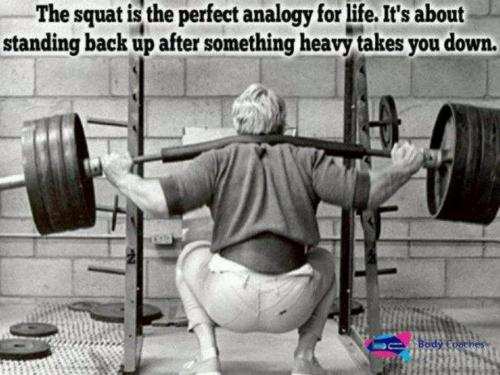
          Dynamic mobility is a fancy term for being strong and flexible while moving; mobility is just being strong through an entire range of motion. So, doing squats with your thighs above parallel (tsk-tsk Doc) is not lifting through the full range of motion; if this guy follows this recommendation, he will not only be limiting his own mobility which can be harmful, he will also be getting weaker because the author thought it correct to tell him to start with his bodyweight or full milk jug which is a whopping 8lbs (tsk-tsk author). Limiting his mobility combined with his age is a recipe for disaster.

First, squatting all the way down or an ATG squat, is not bad for your knees! Everyone says it puts more pressure behind your patella, so what? Stopping early transfers much more strain to your quad and patellar tendon which can cause tendonitis. ATG squats also involve your knees traveling forward enough to allow your butt to sit down on your heels; this is also NOT bad for your knees or ankles, this is part of being truly mobile. Finally, ATG squats are also essential for back health; not necessarily because they make your back strong –which they do– but because most people injure their backs picking up something light and/or small. It is not heavy enough for them to think about bracing for the load (like a jug of milk), although they should have, so they lift it in a manner that is usually somewhat careless and they injure their backs. Something this light could have easily been squatted down to, as babies do naturally, and lifted with a set and braced back if they are mobile enough to do so.

Second, we are much too soft when it comes to training these days. We have never had to worry about things like this before because our lives were active by design and we were strong until we were very old; now our lives are not near as hard, there is not as much asked of us, so in our old age we begin to become very frail. This frailty is due to the thought process that just because people are old they can’t lift heavy or workout hard –both are wrong! To protect them into their later years, the elder population should be lifting heavy and hard as long as they can. Sure, heavy for them will not be heavy for a younger person, but it’s about taxing the body. So, to clarify, the bodyweight squats recommended by the doc and the milk jug squats recommended by the author are both fine if the guy is not active and healthy. If he is active and healthy, these recommendations will literally make him weaker through de-training. Your body likes very much to work by the principle of “use it or lose it” so if you aren't using the strength or muscle that you have worked so hard for, your body it will take it away because it takes energy to maintain that. So, squatting a milk jug when you can obviously handle more is just silly; this guy should be squatting with a loaded barbell at least once a week, if not twice. He doesn't have to be a gym rat, but he can’t be afraid to work hard and lift heavy either.

          Some different lifts that the older population could benefit from are squats (full depth!), deadlifts, overhead pressing, pull ups (assisted or pull downs on a machine), push ups, and rowing variations. These are all very basic movements that can be easily done in most commercial gyms (except the deadlift because commercial gyms are becoming more and more soft as well) that will help you maintain strength in all areas of your body as well as a great deal of mobility that will transfer to everyday life. As I said earlier, the rep schemes don’t have to be anything crazy either. Four sets of five reps at the same weight after warming up will be more than enough to start with and all you have to do is add a little more weight when those four sets become easy. After five or six weeks, do a lighter lifting week, and then repeat. Lifting and training doesn't have to be hard, you just have to be willing to put in the time and effort.
Jack Lalanne was a great example for physical health. He was 91 in this picture... give that a try young people!                               
          I don’t know where these myths of training began to stem from, but they have about as much merit as did muscle-binding; lifting through a full range-of-motion is really the best way for your body to stay truly healthy in to your later years. It will help your maintain your independence, your mobility, your weight, your energy levels, and your quality of life. If you are young, realize early that lifting is an important part of being active. Maybe it is because lifting through a full range is harder, takes a bit longer, and it is harder to lift really heavy loads of weight in short amounts of time –essentially beats people’s egos up. People seem to like to inherently take the easy way out –even more-so now than ever before. We are constantly looking for the quick fix, the magic pill, the best way to burn fat in a certain area (which does NOT HAPPEN under any circumstances) instead of finding the two solutions that will for sure make you healthy: eating right and exercising. Eating right will be what causes fat loss; there is no way around it –not even exercising! Exercising, which includes lifting through a full range-of-motion, is incredibly important for the reasons mentioned earlier in the paragraph. There are no quick fixes, six-minute abs, or magic pills out there that will do all the work for you. Old or young, buckle down and be willing to put in the work and stop being soft. With regards to lifting, training, and life: you reap what you sow.

-Chris


Growth and Improvement Part 1 - Measurements

By Jeff


Have you ever set a goal, got ¾ of the way to achieving that goal (in a relatively short amount of time), and then plateau never hitting the goal? This is a pretty common occurrence in every aspect of life. You want to drop 30 lbs to get in the normal BMI range (BMI is an entire topic of it's own but it is still an OK health indicator for the majority of the population). So you work hard and drop 15 pounds in 5 weeks, only to lose 5 more pounds in the following 10 weeks never hitting you 30 lbs weight loss goal. Or you want to break a 6 minute mile so you cut your mile time to 6:30 at first and plateau at 6:25. I'm sure this has happened to all of us on multiple occasions. This write-up will be a multi-post article geared towards what I talked about above – improvement or even better - growth.

Ask yourself the question, what is my purpose in life? If you are religious your answer would probably be “spiritual growth” - to grow closer to God, to your family, friends and neighbors. If you are not religious your answer would probably be “to live” (in a very generic sense). But I would be incorrect to say atheists aren't constantly striving for growth either. However, this is a fitness and health blog, why bring up the purpose in life? The answer is because everything is interconnected. Your physical health improves/grows, you feel better mentally, therefore your mental health grows, this could only lift your spirit (spiritual growth), all of which makes you more available to improve your spiritual health even further. So to sum it up, taking two hours a week (out of a total of 168 hours in a week) to grow physically, can have a drastic effect on your overall well-being as a human (physically, mentally, emotionally, spiritually).

The topic of the first “growth” post will be on measurement. 


Measurement can go a long way in growth. When you are little kid you know that you are growing bigger by always having to buy bigger and bigger shoes, and by measuring how tall you are. Those are obvious measurements that don't need any record keeping. In terms of fitness – you can measure your body weight, body fat %, heart rate, mile time (or any distance), length or heights (think field events in track and field), or weight of the object your are lifting. If you want to dig even further you can measure efficiencies, probabilities, percentages, standard deviations, or anything you can learn from a statistics class. The point is measurements are a bulletproof way to tell you if you are improving or not and recording your measurements in a spreadsheet and running statistics on them can help you develop a bulletproof way on breaking plateaus. However, you will have to wait for another post to hear more detail on these measurements.

The measurements that I want to talk about today are more generic then the above paragraph. They are tailored to help you identify what goals you truly want to achieve aka “how bad do you want it?” What I recommend is to keep a diary, for most people this would be their smartphone. And write down every single negative thought or complaint that ever crosses your mind. Yeah, this is a little extreme, but the more you write down the higher your chances to grow in the long run. Go back through all of your Facebook posts, emails, old diaries, tweets...anything that records your thoughts and look for negative thoughts or complaints and compile them into one location. You can probably sense where I'm going with this. All of this record keeping are measurements. Start tallying up which negative thoughts cross your mind the most often, and you know the high counts to the most crucial thing you need to grow or improve on. Not only will this help identify what goals you truly want to achieve, it will help you vent and will help your emotional health grow.


So there you have it. Step 1 for growth – measurements. The next post will be titled “goal setting” and will cover how to turn your measurements into goals.

Friday, March 8, 2013

Friday fit tip....insanity (not the tv infomercial)

Insanity, yes it's one of those infomercial workout videos, but insanity is also all around us. Insanity is prevalent in the gym. Insanity is in every aspect of our day to day lives. What do I mean? Keep reading and find out.

Insanity, you might think of it as a mental lack of controlling ones emotions, it might be acting extreme, overreactions, and being completely off the spectrum of what normal emotions and actions look like. Insanity brings images of "crazy people" but what if I told you insanity is probably something you're doing right now.

Albert Einstien, one of the most brilliant thinkers of all of humanity defined insanity as doing the same thing over and over again with the same desired outcome, without ever seeing the results. Now you might see where I am going with this, we all experience a realm of insanity, and I am not one to cast the first stone here, nor will I get into the intricacies of insanity with life. I am here to talk about fitness.

What is insanity in fitness? How many times have you stepped on the treadmill, went fr a run, or got a simple resistance training routine in and done exactly the same thing over and over again. A person does this, expecting to see results, they go through the motions, they shortly are discouraged and give up. I see people in the gym with the tiny dumbells doing endless reps, (I doubt they're even counting) day in and day out. This is what insanity is, they expect to see results, they expect to slim down and "tone" up.

If you're fitness gains are lacking, take the insanity (no pun intended for the imformercial) out of your routine. Do something completely different, get on a structured training program, record your results, set goals. You'll see that fitness gains are simpler than we "experts" like to make it sound. You'll reach your goals, you'll look better, you'll feel great.

One thing I have learned over the years is that principals I apply to my fitness, have a direct transfer to everyday life. Something I can apply to training, eventually get intertwined into my everyday reality. Take this as a lesson, apply it to one realm of your life and watch it spread.

By the way, give our man Chris a shout out for his birthday 24 years young today!
In health and happiness
Andrew

Tuesday, March 5, 2013

Why we struggle with change

Is it any wonder why over two thirds of our population is obese? Isn't it hard to begin an exercise and diet program and become fit? Our society lives in an illusion that it is hard, it takes tremendous work, and there isn't enough time, money, or energy in their lives to be fit. I'll go ahead and lay that to rest right now. It is incredibly easy to stay thin, to be relatively fit, and to have a healthy life. 

Not what you wanted to hear? It is the reality, along with many other truths we run away from on a daily basis. It is very easy to cook your own meals on a shoestring budget, get out and spend 20-30 minutes exercising, and keeping yourself healthy. Why is it so hard for us to buy into it?

Humans nature is strange the paradox of our normal behavior is everyone wants a slim body, ripped muscles, and the ability to run, jump, lift, and play. However, as simple as it is to achieve this we wish for the outcome but never bother taking the steps towards making these intentions a reality. In order to do so, you must combine driven intentions toward the desired outcome.

How do we take steps toward our desired outcomes? It's quite obvious we don't wake up one morning with the motivation and drive to dive right in. Often we make the choice to try this diet or that program, but who can honestly say they're still on the program? The yo-yo dieting and flip flop fitness is a major issue here. To make anything stick you have to integrate it into your life.

As research has shown, it takes 21 days to form a habit, 21 days is a long time. Few people who are seriously out of shape can attest to maintaining something for 21 days. I know that it is quite achievable, and if you can, more power to you but starting small is a good step to take. Try 5 days. Then 10, eventually built up until you make it part of your life.

Another way to make something stick is to attach something of worth to it. Whether you pledge $50 that is only returned when you maintain a routine for a given time, or challenge yourself with a friend. The idea that you are working for something can be a great kickstarter (as if knowing you'll lif 10-15 years of a longer, active, more adventurous life isn't enough). This is only a starter though, once a habit you will no longer need these gimmicks to get yourself motivated.

Take a picture of yourself, in a not so flattering way. Attach this somewhere where you'll see it everyday. You'll be amazed at the power this has to ignite a fire of motivation. Review your progress every thirty days, it's amazing how quickly our bodies can change when under the right circumstances.

Now are you ready to take your intentions and turn them into driven actions? I know it's not easy, I struggle with it in many aspects as well. Message me for more advice and any questions about how to integrate a healthier, more active routine into your life.

as always, in health, and happiness
Andrew

Friday, March 1, 2013

Friday fit tip....getting more out of your cardio

In our modern times the notion is often held that is some is good, more must be better. This paradox blankets many aspects of our lives. In the gym, I see people plodding away on a treadmill for and hour or more. To me this seems like a nonsensical approach to fitness in a time where everyone has an excuse on how little time they have. Time, the number one excuse for why people can't make it to the gym is a sad excuse.

Although I can expand an entire post on time management, I assume you "don't have the time" to read an entire article on how to approach time management. Instead I'll give you some practical ideas on how to get the most out of a cardio session at the gym. The caveat here is that everything I will outline below will take you between 20-30 minutes and, you'll see better results than the typical jaunt on the treadmill, bike, of elliptical  Sounds like the start of an infomercial, but what I am about to share has very simple science behind it and there is no bonus for calling in the next 20:00 (although you could get a good workout in and still have time left in 20:00)

When many of us think of cardio, what comes to mind, the hamster wheel is what pops into my head, along with the skinny guys with a body fat percentage in the 20's plodding away at 4mph for 60min to "lose weight  (which is probably just further muscle wasting). This image should go the way of jazzercise and Richard Simmons  into the youtube vault of exercise comedy. Let's examine "chronic cardio" with basic scientific principals. Yes, you may argue that at 60% intensity, you are solely burning fat as fuel. However, you may not know that the amount you are burning is far less than say if you were at 90%. The other issue is the basic biological principal that your body will adapt to the stressed placed on it. Your 60min session, while at a comfortable pace still gets you breathing and sweating isn't doing much for changes in body chemistry that would invoke adaptations to body mass or fitness. At a comfortable level you're doing nothing but exercising within your current fitness.

The solution you ask? Interval training. With a solid interval set, we can improve fitness, spark our body to adapt, and invoke chemistry responses all at a minimal time requirement. Pushing yourself beyond the comfort zone, for brief intervals of time, followed by recovery jogging or rest yield tremendous results. Let's apply some basic exercise science. MET's are the currency we use to measure the cost of activity on your body, its how much energy is required to perform a task. Brisk walking or a slow jog, requires about 4.5 MET's. Running, at a 6min mile pace (not even close to the speed you can achieve in a short interval) costs us 16 MET's. As you can see, that's over three times as much energy. Someone can easily jump up four fold from the typical cardio pace. If we are exercising at 4 times the MET's we are going to achieve much more.

Here is a little math if we do intervals at 20 MET's for :30 followed by :30 jog we end up at an average of 12.25 MET's averaged per min. Let's repeat the interval 10 times for a 10min total workout. That's a total of 122.5 MET's. To get the same energy expenditure from the typical pace, you'd have to jog for 28min. We get almost 3 times the energy expenditure all other variables equal. This isn't the only benefit, caloric afterburn, V02 max development, the rush of endorphin's  hormones, and enzymes also turn our body into a fat burning incinerary.

Now hopefully I have convinced you fitness can take as little as 20min of your day. Start slow, and build up. Intervals are an excellent way to get more out of your training. There are 100's of different ways too incorporate them into a workout. Message me for some ideas!